Scars, or the Marks Left Behind?
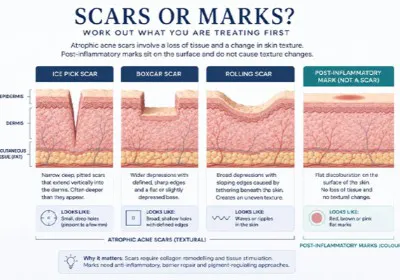
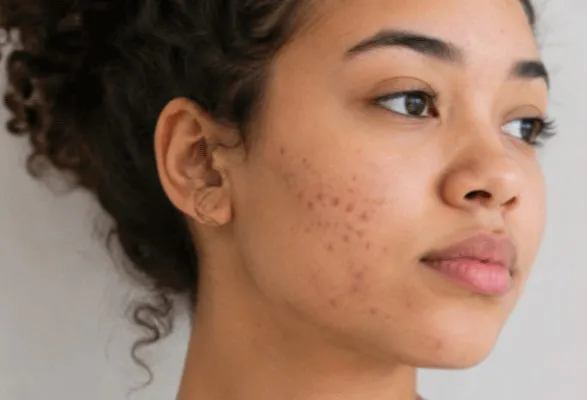
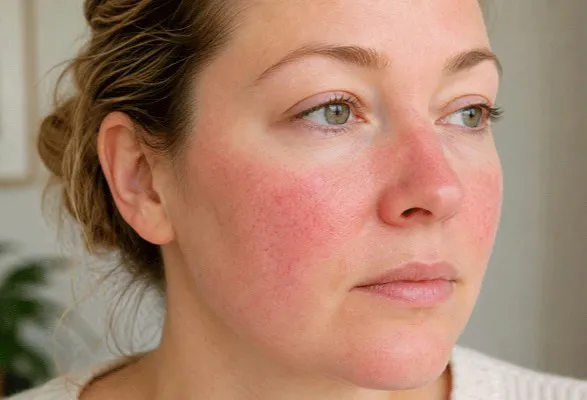
A lot of what people label as scarring is not actually scar tissue, and sorting this out first will save both time and money. True acne scars are textural: the surface sits unevenly because collagen was lost as the skin healed, and these dips do not smooth out by themselves. Flat red or brown patches are different again, usually leftover discolouration that fades over weeks or months.
The textural (atrophic) kind falls into three familiar shapes: narrow, deep ice pick pits; wider boxcar dips with defined edges; and shallow, sloping rolling depressions. A quick way to check at home is to view your skin in side lighting or gently stretch it. If the indentation stays, it is likely a genuine scar. If a flat coloured patch is all you see, that is a mark. Most people, in truth, have a combination.
Why does this distinction matter here? LDM® Triple is at its most useful where inflammation, redness and mild texture are the issue, which leans towards the marks-and-surface end rather than deep, set pits.
How the Ultrasound Actually Works
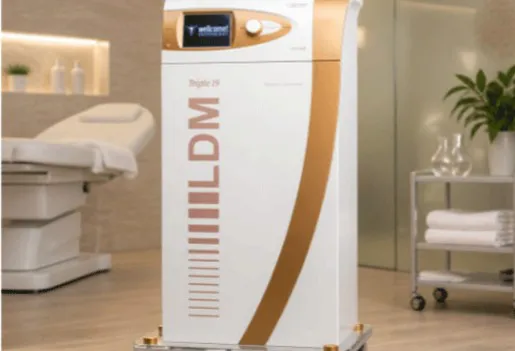
LDM® stands for Local Dynamic Micro-massage, and the “Triple” points to its defining feature: it switches between several ultrasound frequencies (from 1 through to 19 MHz) within milliseconds, so more than one skin depth is worked at the same time. Rather than wounding the skin to trigger repair, as a laser or needle would, it uses ultrasound to lower inflammation and encourage the skin’s own recovery. Practitioners often connect this to its effect on Caveolin-1, a protein tied to inflammation and healing. It is non-ablative, meaning the surface stays intact, and sessions usually run to about 15 to 30 minutes.
Learn more about the LDM® Triple technology →
What the Research Does and Does Not Show
Here honesty matters. The strongest published evidence so far concerns active acne rather than established scars. A 2025 two-centre study of 22 patients with mild to severe acne recorded acne severity falling by around 74 per cent by the final session, improving to roughly 90 per cent at follow-up. Those numbers describe how well it calms active acne, which is often what generates fresh marks in the first place.
It was a small, retrospective study, so it is best read as promising early evidence for the treatment’s soothing, repair-focused action. Used as a standalone course, LDM® Triple can realistically soften how scarring looks, even out tone, reduce redness and support a smoother surface, without claiming to fill deep pits.
Comfort and the Pace of Results
For anyone put off scar treatment by the thought of pain or visible peeling, comfort is a genuine draw. Most people liken the sensation to a warm, gentle massage, with no needles and no numbing cream needed. Afterwards there is usually nothing more than brief, mild redness, and normal activities resume straight away.
The trade-off for that gentleness is pace. A single session will not transform the skin, and a course of roughly six to ten treatments is the norm, with improvement appearing steadily and often continuing once the course ends. None of this is a drawback so much as a fair expectation to hold from the outset.
Weighing It Against Laser and Needling
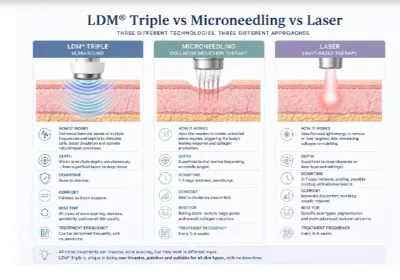
The clearest way to place LDM® Triple is against the treatments people already know. Laser resurfacing and microneedling deliberately create controlled injury, which is what lets them tackle deeper scars, but that also brings some discomfort and a recovery period of anything from a day or two to more than a week. Microneedling typically runs as a course of three to six sessions, while laser treatment sometimes requires fewer sessions.
LDM® Triple works the other way around. Because it never breaks the skin, it is comfortable and downtime-free, but that same gentleness makes it less forceful on set, well-defined pits. In short, deeper scars point towards a firmer treatment or a combined plan, while redness, tone and milder texture sit comfortably in LDM® Triple’s territory. Neither route is simply superior; they suit different skin and different tolerances for recovery.
What It Costs, and Who Gains Most
As a guide, published UK pricing puts a single LDM® Triple session at around £295, with course pricing lowering the per-session figure: roughly £1,500 for a course of six and about £2,250 for ten. Since a course is usually advised, the overall outlay is the more useful number to weigh. For context, microneedling tends to run between £150 and £300 a session, radiofrequency microneedling around £250 to £600, and laser resurfacing from about £350 upwards. Worth remembering, too, that scar treatment is considered cosmetic, so it is rarely funded on the NHS and most people pay privately.
As for who benefits most, LDM® Triple tends to suit people with active or recently settled acne, those mainly bothered by redness or mild texture, and anyone with reactive skin that copes poorly with harsher options. Deeper, long-standing scars usually call for something stronger, though the treatment can still add value there by calming the skin alongside other methods.
Before You Book
A short conversation upfront tells you a great deal. It is reasonable to ask what the practitioner thinks you are actually treating, whether LDM® Triple is being suggested alone or within a plan, how many sessions are likely, and what training and insurance they hold. Regulation is tightening, too: in 2025 the UK Government confirmed plans for a licensing scheme covering non-surgical cosmetic procedures in England, with further detail to follow. Until it is fully in force, checking credentials yourself remains wise.
Browse more LDM® Triple insights →
This article is an independently written version of a guide originally published by Anglo Arab Trading on angloarab.co.uk.